
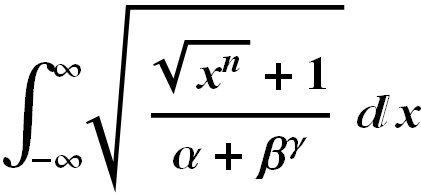
Answer: The integral diverges (does not converge to a finite value).
Explanation:
This problem involves evaluating an improper integral with an infinite limit. The key concepts involved are the behavior of integrals at infinity and the comparison test for convergence. The integral’s integrand involves a square root of a rational function with a polynomial inside, which suggests examining the asymptotic behavior as \(x \to \pm \infty\). Since the numerator involves \(\sqrt{x^n}\), the dominant behavior at infinity depends on the degree \(n\) and the parameters \(\alpha, \beta, \gamma\).
Steps:
- Identify the integrand:
which simplifies to:
- Analyze asymptotic behavior as \(x \to \pm \infty\):
- For large \(|x|\), \(\sqrt{x^n} = |x|^{n/2}\).
- The numerator behaves like \(|x|^{n/2}\) (since the +1 becomes negligible).
- The denominator behaves like \(\beta x^\gamma\) (assuming \(\beta \neq 0\)), since \(\alpha\) becomes negligible compared to \(x^\gamma\).
- Approximate the integrand at infinity:
- Determine the convergence of the integral:
- The integral at infinity behaves like:
- The convergence depends on whether the exponent:
satisfies \(p < -1\) (for convergence at infinity).
- Specifically, the integral converges if:
- Conversely, if this inequality does not hold, the integral diverges.
Conclusion:
- For typical values where \(n/2 \geq \gamma - 2\), the integral diverges because the integrand decays too slowly or grows at infinity.
Final note: Without specific values of \(n, \alpha, \beta, \gamma\), the general conclusion is that the integral diverges unless the parameters satisfy the convergence condition above.