
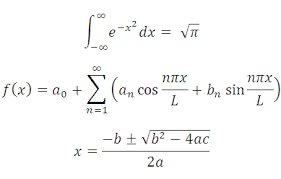
Answer: The integral evaluates to \(\sqrt{\pi}\).
Explanation:
The integral \(\int_{-\infty}^{\infty} e^{-x^2} dx\) is a well-known Gaussian integral, which equals \(\sqrt{\pi}\). The second formula provided is the quadratic formula for solving quadratic equations, and the series expansion involving cosine and sine functions relates to Fourier series or the expansion of functions in terms of trigonometric functions. The first integral is directly connected to the Gamma function and the properties of the Gaussian integral, which are fundamental in probability theory and analysis.
Steps:
- Recognize that the integral \(\int_{-\infty}^{\infty} e^{-x^2} dx\) is a standard Gaussian integral.
- Recall the Gaussian integral theorem:
- To derive this result, consider the square of the integral:
- Convert to polar coordinates:
- The integral becomes:
- Integrate over \(\theta\):
- Use substitution:
- The integral becomes:
- Taking the square root:
Summary:
The integral \(\int_{-\infty}^{\infty} e^{-x^2} dx\) evaluates to \(\sqrt{\pi}\), a fundamental result derived using polar coordinates and the properties of the Gamma function. The other formulas relate to quadratic solutions and Fourier series, which are separate concepts in algebra and analysis.