
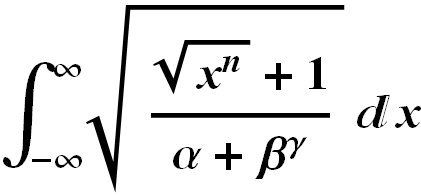
Math question image

3. **Substitution to simplify:**

Answer: The integral converges to a finite value, and its exact evaluation depends on the parameters \( \alpha \) and \( \beta \), but generally, it is a complex integral involving the behavior of the integrand at infinity and near zero.

Explanation:
This integral involves advanced calculus concepts, particularly improper integrals, asymptotic analysis, and possibly special functions depending on the parameters \( \alpha \) and \( \beta \). The integrand contains a square root of a sum involving \( x^n \) and an exponential decay term \( \alpha + \beta^\gamma \), which suggests the use of substitution methods, asymptotic analysis, or special functions like the Gamma or Beta functions for exact solutions. The integral’s convergence depends on the decay rate of the integrand as \( x \to \infty \) and the behavior near \( x \to -\infty \).


Steps:

  1. Identify the integrand:

\[ f(x) = \sqrt{\frac{\sqrt{x^n + 1}}{\alpha + \beta^\gamma}} \]

The integral is:

\[ I = \int_{-\infty}^{\infty} \sqrt{\frac{\sqrt{x^n + 1}}{\alpha + \beta^\gamma}} \, dx \]

  1. Analyze the integrand’s behavior:
  • As \( x \to \pm \infty \):

\[ x^n \to \pm \infty \quad \text{(depending on \( n \) and the sign of \( x \))} \]

  • For large \( |x| \):

\[ \sqrt{x^n + 1} \sim |x|^{n/2} \]

  • The integrand behaves like:

\[ f(x) \sim \frac{|x|^{n/4}}{\sqrt{\alpha + \beta^\gamma}} \]

  • To ensure convergence at infinity, the integral requires:

\[ \int_{-\infty}^{\infty} |x|^{n/4} dx \]

which converges only if \( n/4 < -1 \Rightarrow n < -4 \). Otherwise, the integral diverges.

  1. Substitution to simplify:
  • For the inner square root, consider substitution:

\[ t = x^{n} \]

  • Then:

\[ dt = n x^{n-1} dx \]

  • Express \( dx \):

\[ dx = \frac{dt}{n x^{n-1}} \]

  • But \( x^{n} = t \Rightarrow x = t^{1/n} \), so:

\[ dx = \frac{dt}{n t^{(n-1)/n}} = \frac{dt}{n t^{(n-1)/n}} \]

  • The integral becomes:

\[ I = \int_{t=-\infty}^{\infty} \sqrt{\frac{\sqrt{t + 1}}{\alpha + \beta^\gamma}} \times \frac{dt}{n t^{(n-1)/n}} \]

which simplifies to:

\[ I = \frac{1}{n \sqrt{\alpha + \beta^\gamma}} \int_{-\infty}^{\infty} \frac{\sqrt{\sqrt{t + 1}}}{t^{(n-1)/n}} dt \]

  1. Assessing convergence:
  • The integral’s convergence depends on the behavior of the integrand near the critical points \( t \to 0 \) and \( t \to \pm \infty \).
  • Near \( t \to 0 \):

\[ \sqrt{\sqrt{t + 1}} \sim \sqrt{1} = 1 \]

and the denominator behaves as:

\[ t^{(n-1)/n} \]

which may cause divergence if the exponent leads to non-integrable singularities.

  • Near \( t \to \infty \):

\[ \sqrt{\sqrt{t + 1}} \sim t^{1/4} \]

and the denominator:

\[ t^{(n-1)/n} \]

  • Overall, the integral’s convergence is conditional on the parameters \( n, \alpha, \beta, \gamma \).

Summary:

  • The integral’s convergence depends on the decay rate of the integrand at infinity, which is governed by the exponent \( n \).
  • Exact evaluation may involve special functions, such as the Gamma function, especially if the integral resembles forms like:

\[ \int_{0}^{\infty} x^{p} e^{-q x^r} dx \]

which can be expressed in terms of Gamma functions.

  • Without specific parameter values, the integral’s exact value cannot be expressed simply, but the analysis indicates convergence conditions and the potential for expressing the integral in terms of special functions.

Note: To evaluate this integral explicitly, additional information about the parameters \( n, \alpha, \beta, \gamma \) is necessary, or numerical methods may be employed for specific cases.

Related

Andrea Apple opened Apple Photography on January 1 of the current year. During January, the following transactions occurred and were recorded in the company’s books: 1. Andrea invested $13,700 cash in the business. 2. Andrea contributed $22,000 of photography equipment to the business. 3. The company paid $2,300 cash for an insurance policy covering the next 24 months. 4. The company received $5,900 cash for services provided during January. 5. The company purchased $6,400 of office equipment on credit. 6. The company provided $2,950 of services to customers on account. 7. The company paid cash of $1,700 for monthly rent. 8. The company paid $3,300 on the office equipment purchased in transaction #5 above. 9. Paid $295 cash for January utilities. Based on this information, the balance in the A. Apple, Capital account reported on the Statement of Owner’s Equity at the end of the month would be: Multiple Choice $34,200. $41,600. $33,550. $42,555. $32,855. Is the service revenue on account added to the revenue, and what about the prepaid insurance payment do you add that to expenses when figuring net income?

Carla Vista Corporation purchases a patent from Sandhill Company on January 1, 2024 for 99,120. The patent has a remaining legal life of 16 years. Carla Vista feels the patent will be useful for 10 years. Assume that at January 1, 2026, the carrying amount of the patent on Carla Vista’s books is 79,296. In January, Carla Vista spends $23,600 successfully defending a patent suit. Carla Vista still feels the patent will be useful until the end of 2033. Prepare Carla Vista’s journal entries to record straight-line amortization for 2024 and 2026. (Credit account titles are automatically indented when the amount is entered. Do not indent manually. If no entry is required, select “No Entry” for the account titles and enter 0 for the amounts. List all debit entries before credit entries. Record entries in the order displayed in the problem statement.) Date Account Titles and Explanation Debit Credit

Ivanhoe Corporation purchased Oriole Company 3 years ago and at that time recorded goodwill of 705,600. The Division’s net identifiable assets, including the goodwill, have a carrying amount of 1,176,000. The fair value of the division is estimated to be $1,078,000. Prepare Ivanhoe’s journal entry, if necessary, to record the impairment of the goodwill. (Credit account titles are automatically indented when the amount is entered. Do not indent manually. If no entry is required, select “No Entry” for the account titles and enter 0 for the amounts. List debit entry before credit entry.) Account Titles and Explanation Debit Credit