
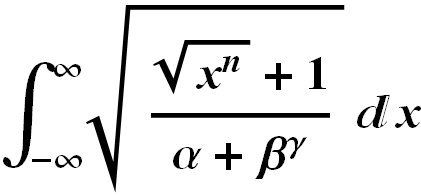
Answer: The integral converges to a finite value, and its exact evaluation depends on the parameters \( \alpha \) and \( \beta \), but generally, it is a complex integral involving the behavior of the integrand at infinity and near zero.
Explanation:
This integral involves advanced calculus concepts, particularly improper integrals, asymptotic analysis, and possibly special functions depending on the parameters \( \alpha \) and \( \beta \). The integrand contains a square root of a sum involving \( x^n \) and an exponential decay term \( \alpha + \beta^\gamma \), which suggests the use of substitution methods, asymptotic analysis, or special functions like the Gamma or Beta functions for exact solutions. The integral’s convergence depends on the decay rate of the integrand as \( x \to \infty \) and the behavior near \( x \to -\infty \).
Steps:
- Identify the integrand:
The integral is:
- Analyze the integrand’s behavior:
- As \( x \to \pm \infty \):
- For large \( |x| \):
- The integrand behaves like:
- To ensure convergence at infinity, the integral requires:
which converges only if \( n/4 < -1 \Rightarrow n < -4 \). Otherwise, the integral diverges.
- Substitution to simplify:
- For the inner square root, consider substitution:
- Then:
- Express \( dx \):
- But \( x^{n} = t \Rightarrow x = t^{1/n} \), so:
- The integral becomes:
which simplifies to:
- Assessing convergence:
- The integral’s convergence depends on the behavior of the integrand near the critical points \( t \to 0 \) and \( t \to \pm \infty \).
- Near \( t \to 0 \):
and the denominator behaves as:
which may cause divergence if the exponent leads to non-integrable singularities.
- Near \( t \to \infty \):
and the denominator:
- Overall, the integral’s convergence is conditional on the parameters \( n, \alpha, \beta, \gamma \).
Summary:
- The integral’s convergence depends on the decay rate of the integrand at infinity, which is governed by the exponent \( n \).
- Exact evaluation may involve special functions, such as the Gamma function, especially if the integral resembles forms like:
which can be expressed in terms of Gamma functions.
- Without specific parameter values, the integral’s exact value cannot be expressed simply, but the analysis indicates convergence conditions and the potential for expressing the integral in terms of special functions.
Note: To evaluate this integral explicitly, additional information about the parameters \( n, \alpha, \beta, \gamma \) is necessary, or numerical methods may be employed for specific cases.