
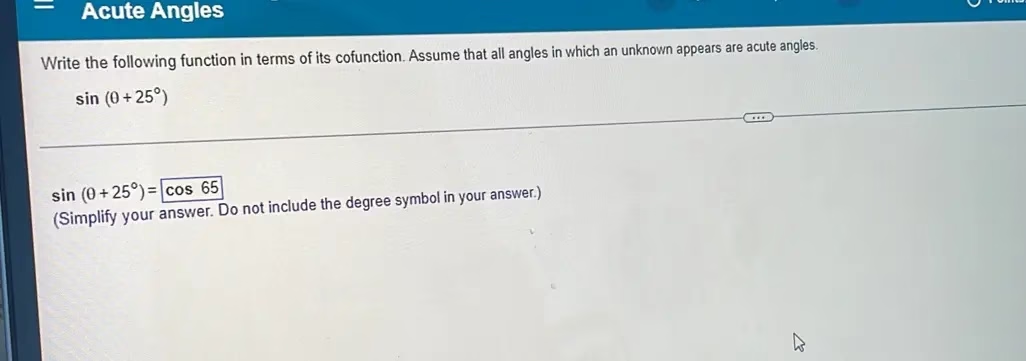
The correct answer is: $\cos(65-\theta)$
Explanation
We use the cofunction identity for sine and cosine (angles in degrees):
$\sin x=\cos(90-x)$.
Steps:
- Let $x=\theta+25$. Apply the identity:
$$\sin(\theta+25)=\cos(90-(\theta+25))$$
- Simplify inside the cosine:
$$\cos(90-(\theta+25))=\cos(90-\theta-25)=\cos(65-\theta)$$
Therefore $\sin(\theta+25)=\cos(65-\theta)$. (As a check, using the evenness of cosine one may also write $\cos(65-\theta)=\cos(\theta-65)$, so both forms are equivalent.)
Summary: By the cofunction identity $\sin x=\cos(90-x)$ and direct substitution $x=\theta+25$, the expression simplifies to $\cos(65-\theta)$ (degrees implied; the final answer omits the degree symbol as requested).