
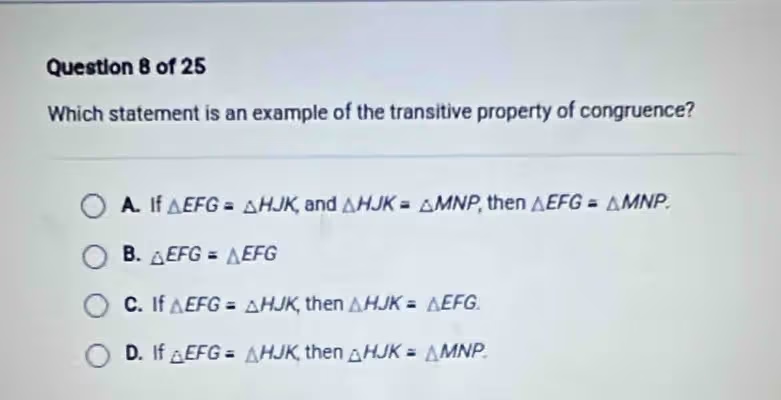
The correct example is: If segment AB ≅ segment CD and segment CD ≅ segment EF, then segment AB ≅ segment EF.
Explanation
- The transitive property of congruence says that if one object is congruent to a second, and that second is congruent to a third, then the first is congruent to the third.
- In symbols: if $X\\cong Y$ and $Y\\cong Z$, then $X\\cong Z$.
- This applies to segments (as above), angles (e.g., if ∠1 ≅ ∠2 and ∠2 ≅ ∠3, then ∠1 ≅ ∠3), and other geometric figures.
Thus the statement above is a direct example of the transitive property of congruence.