
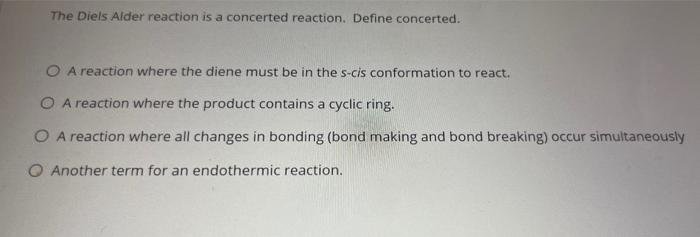
Answer: A reaction where all changes in bonding (bond making and bond breaking) occur simultaneously.
Explanation: In chemistry, a concerted reaction is one where all bond-breaking and bond-forming processes occur in a single step without intermediates. The Diels-Alder reaction is a classic example of a concerted reaction, where the π bonds in the diene and dienophile rearrange simultaneously to form a new cyclic compound.
Steps:
- Identify the Reaction Type: The Diels-Alder reaction is a pericyclic reaction, specifically a [4+2] cycloaddition.
- Understand Concerted Mechanism: In a concerted mechanism, all bond changes occur in one step. There are no intermediates formed during the reaction.
- Apply to Diels-Alder: In the Diels-Alder reaction, the diene and dienophile interact directly, forming new σ bonds while π bonds are broken and formed simultaneously.
- Select the Correct Definition: Among the given options, the one that describes a concerted reaction is where all changes in bonding occur simultaneously.