
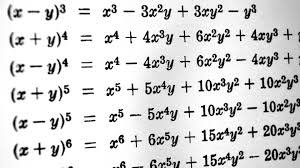
Answer: The general expression for the expansion of \((x - y)^6\) is \(x^6 - 6x^5 y + 15x^4 y^2 - 20x^3 y^3 + 15x^2 y^4 - 6x y^5 + y^6\).
Explanation:
This problem involves the binomial theorem, which states that for any positive integer \(n\):
\[
(x + y)^n = \sum_{k=0}^n \binom{n}{k} x^{n-k} y^k
\]
In this case, since the binomial is \((x - y)^6\), we can write:
\[
(x - y)^6 = \sum_{k=0}^6 \binom{6}{k} x^{6-k} (-y)^k
\]
which simplifies to:
\[
(x - y)^6 = \sum_{k=0}^6 \binom{6}{k} x^{6-k} (-1)^k y^k
\]
This involves the binomial coefficients \(\binom{6}{k}\), which are known as binomial coefficients and can be found in Pascal’s triangle or calculated as:
\[
\binom{6}{0} = 1,\quad \binom{6}{1} = 6,\quad \binom{6}{2} = 15,\quad \binom{6}{3} = 20,\quad \binom{6}{4} = 15,\quad \binom{6}{5} = 6,\quad \binom{6}{6} = 1
\]
Steps:
- Write the binomial expansion for \((x - y)^6\):
\[
(x - y)^6 = \sum_{k=0}^6 \binom{6}{k} x^{6-k} (-1)^k y^k
\]
- Calculate each term:
- For \(k=0\):
\[
\binom{6}{0} x^{6} (-1)^0 y^{0} = 1 \times x^{6} \times 1 \times 1 = x^6
\]
- For \(k=1\):
\[
\binom{6}{1} x^{5} (-1)^1 y^{1} = 6 \times x^{5} \times (-1) \times y = -6x^5 y
\]
- For \(k=2\):
\[
\binom{6}{2} x^{4} (-1)^2 y^{2} = 15 \times x^{4} \times 1 \times y^2 = 15x^4 y^2
\]
- For \(k=3\):
\[
\binom{6}{3} x^{3} (-1)^3 y^{3} = 20 \times x^{3} \times (-1) \times y^3 = -20x^3 y^3
\]
- For \(k=4\):
\[
\binom{6}{4} x^{2} (-1)^4 y^{4} = 15 \times x^{2} \times 1 \times y^4 = 15x^2 y^4
\]
- For \(k=5\):
\[
\binom{6}{5} x^{1} (-1)^5 y^{5} = 6 \times x \times (-1) \times y^5 = -6x y^5
\]
- For \(k=6\):
\[
\binom{6}{6} x^{0} (-1)^6 y^{6} = 1 \times 1 \times 1 \times y^6 = y^6
\]
- Combine all terms:
\[
(x - y)^6 = x^6 - 6x^5 y + 15x^4 y^2 - 20x^3 y^3 + 15x^2 y^4 - 6x y^5 + y^6
\]
This expansion uses the binomial theorem and binomial coefficients.