
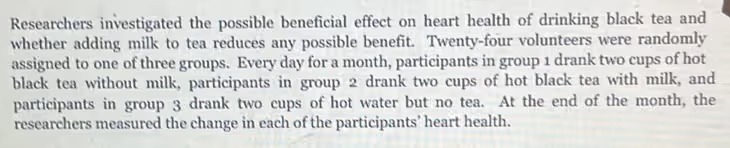
This is a randomized controlled trial (a randomized experiment) with three parallel groups.
Explanation (quick)
- Participants were randomly assigned to one of three treatment arms, so this is an experiment (not observational).
- The independent variable is the drink condition (black tea without milk, black tea with milk, or hot water).
- The dependent variable is the measured change in each participant’s heart health after one month.
- Group 3 (hot water) acts as a control; comparing group 1 vs group 2 tests whether adding milk modifies any tea effect.
What this implies for causality and analysis
- Because of random assignment, differences in outcomes between groups can be interpreted causally (i.e., due to the drink conditions), assuming randomization was implemented properly and there is no major differential dropout or noncompliance.
- With 24 volunteers total, sample size is small (likely 8 per group), so statistical power is low and results will be imprecise.
Recommended analysis steps
- Inspect baseline comparability (age, sex, baseline heart-health measures) to check randomization balance.
- Calculate the outcome for each subject: the change in heart health (post − pre).
- Summarize by group: mean, SD, median, IQR; plot boxplots.
- Test overall differences across the three groups:
- If assumptions hold (approx. normal residuals and homoscedasticity): one-way ANOVA on change scores.
- If not: Kruskal–Wallis test or a permutation ANOVA.
- If the overall test is significant, do pairwise comparisons:
- Planned contrasts: (a) tea overall vs water: compare pooled groups 1+2 vs group 3; (b) milk effect: group1 vs group2.
- Use Tukey or Bonferroni correction (or report unadjusted planned contrasts if pre-specified).
- Report effect sizes (Cohen’s d or mean difference) and 95% confidence intervals. With small n, consider bootstrap CIs or exact permutation tests.
- If baseline values vary, consider ANCOVA with baseline heart-health as covariate (more powerful than analyzing change scores if assumptions met).
Limitations and threats to validity
- Small sample → low power and wide CIs.
- Possible lack of blinding (participants likely knew whether their tea contained milk) → risk of placebo/expectation effects.
- Compliance measurement (did participants drink both cups daily?) and any co-interventions should be recorded.
- Short duration (1 month) may limit clinical relevance.
- External validity: volunteers and study conditions may not generalize.
Improvements for a stronger study
- Larger sample size (power calculation beforehand).
- Blinding if feasible (e.g., use flavor-masked placebo or decaffeinated tea with similar taste) or at least blinded outcome assessment.
- Pre-register primary outcome and analysis plan.
- Longer follow-up and objective heart-health measures (e.g., biomarkers, BP, endothelial function).
- Monitor adherence and adverse events.
If you want, I can write the R or Python code to run the recommended analyses (ANOVA, contrasts, assumption checks, bootstrap CIs) on a sample dataset or your real data.