
Answer:
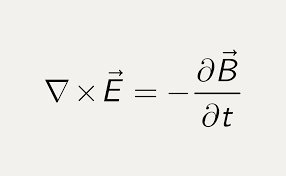
The equation shown is Faraday’s Law of Electromagnetic Induction in differential form, specifically one of Maxwell’s equations known as Faraday’s Law.
Explanation:
This equation expresses how a time-varying magnetic field induces an electric field. It is derived from Maxwell’s equations, which describe the fundamental relationships between electric and magnetic fields. The equation states that the curl of the electric field \(\vec{E}\) is equal to the negative rate of change of the magnetic flux density \(\vec{B}\) with respect to time. This is a differential form of Faraday’s Law, emphasizing local field behavior rather than the integral form.
Steps:
- Identify the components:
- \(\nabla \times \vec{E}\): The curl of the electric field, representing the rotation or circulation of \(\vec{E}\).
- \(\frac{\partial \vec{B}}{\partial t}\): The partial derivative of magnetic flux density \(\vec{B}\) with respect to time, indicating how \(\vec{B}\) changes over time.
- Recall the relevant theorem:
- Maxwell’s Equations: The differential form of Faraday’s Law is derived from Faraday’s Law of induction, which states that a changing magnetic flux induces an electric field.
- Mathematical concept involved:
- Vector calculus: Specifically, the curl operator \(\nabla \times\) and partial derivatives.
- Faraday’s Law: \(\nabla \times \vec{E} = - \frac{\partial \vec{B}}{\partial t}\).
- Physical interpretation:
- When magnetic fields change over time, they produce a non-conservative electric field (not derivable from a scalar potential), which is described by this differential equation.
Summary:
This equation is a fundamental law in electromagnetism, illustrating how a time-varying magnetic field creates a circulating electric field, a principle that underpins transformers, electric generators, and many other electromagnetic devices.