
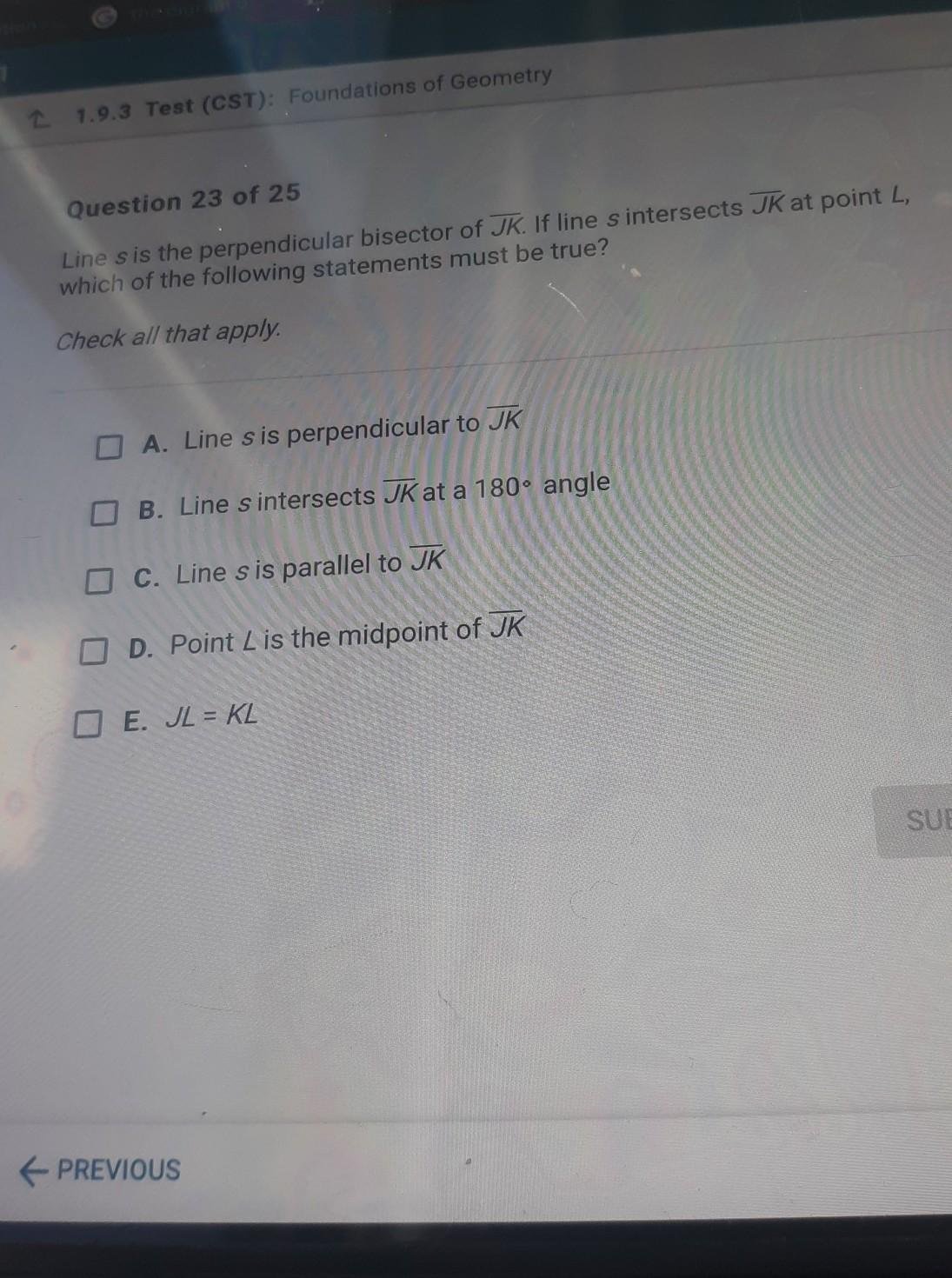
Answer: A, D, E
Explanation: Subject: Geometry. Relevant concept: perpendicular bisector (and the Perpendicular Bisector Theorem). By definition, a perpendicular bisector of segment JK is a line that (1) is perpendicular to JK and (2) bisects JK (cuts JK into two equal parts). Therefore:
- A is true because “perpendicular bisector” means the line is perpendicular to JK.
- D is true because “bisector” means it meets JK at its midpoint.
- E is true because if L is the midpoint then \(JL = KL\).
B is false because intersection at a 180° angle would be a straight (collinear) angle, not perpendicular (which is 90°). C is false because a perpendicular bisector cannot be parallel to the segment it bisects.
Steps:
- State definition: A perpendicular bisector of segment JK is a line that is perpendicular to JK and passes through JK’s midpoint.
- From the definition, line s is perpendicular to JK → select A.
- From the definition, line s intersects JK at its midpoint L → select D.
- Midpoint L implies the two segments are equal: \(JL = KL\) → select E (Perpendicular Bisector Theorem also implies any point on the perpendicular bisector is equidistant from J and K).
- Reject B: intersection at 180° is incorrect (perpendicular means 90°).
- Reject C: a line parallel to JK cannot be perpendicular and cannot bisect JK where they don’t meet.