
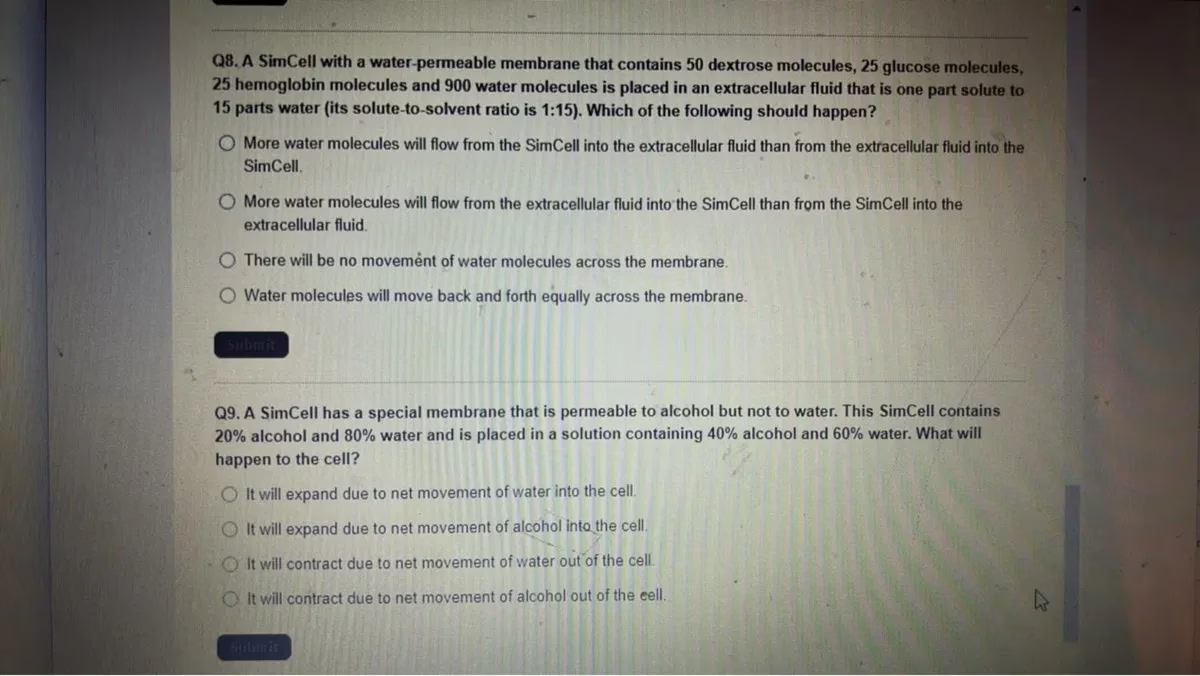
Q8: Water will flow into the SimCell (the cell is hypertonic to the outside), so the cell will swell and may burst.
Q9: Alcohol will diffuse into the SimCell until alcohol concentrations equalize (reach ~40% inside); because water cannot cross, the cell will take up alcohol and increase in volume (swell), possibly rupturing if the membrane cannot stretch.
Q8 — Explanation
The cell contains 50 dextrose + 25 glucose + 25 hemoglobin = 100 solute molecules and 900 water molecules, so the intracellular solute-to-water ratio is
- $100:900 = 1:9$ (solute:water), i.e. solute fraction $= \dfrac{1}{1+9}=0.10$ (10%).
The extracellular fluid has solute-to-water ratio $1:15$, solute fraction $=\dfrac{1}{1+15}=0.0625$ (6.25%).
Because the inside has a higher solute concentration than the outside, the inside is hypertonic relative to the outside. With a membrane permeable to water, osmosis will move water from the extracellular solution (lower solute concentration) into the cell (higher solute concentration). That influx of water causes the cell to swell and can lead to lysis if the membrane cannot accommodate the increased volume.
Q9 — Explanation
Initial concentrations: inside 20% alcohol / 80% water; outside 40% alcohol / 60% water. The membrane is permeable to alcohol but impermeable to water, so:
- Alcohol will diffuse down its concentration gradient from outside (40%) into the cell (20%) until alcohol concentrations equalize (about 40% inside at equilibrium).
- Water cannot cross the membrane, so there is no compensating osmotic movement of water.
- As alcohol molecules enter, the total volume (and solute content) inside increases, so the cell will swell (increase in volume). If the membrane cannot expand enough, it can rupture.
Note: If the membrane were freely permeable to both alcohol and water, both would redistribute and osmotic/equilibrium effects would differ; because water is blocked here, solute diffusion alone changes internal volume.