
Subject: Biology (Evolution and Natural Selection)
Q1:
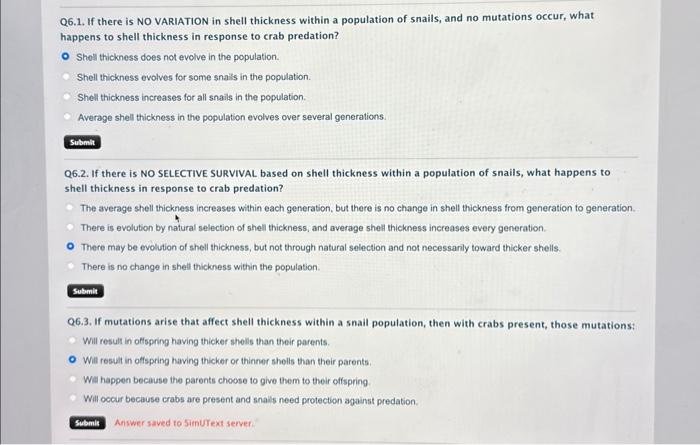
Answer: Shell thickness does not evolve in the population.
Explanation: Without variation or mutations, there is no genetic diversity for natural selection to act upon, so shell thickness remains unchanged.
Steps:
- Identify the lack of variation and mutations.
- Understand that evolution requires genetic variation.
- Conclude that without these, no evolutionary change occurs.
Q2:
Answer: There is no change in shell thickness within the population.
Explanation: Without selective survival, there is no differential reproduction based on shell thickness, so no evolutionary change occurs.
Steps:
- Recognize the absence of selective survival.
- Understand that natural selection requires differential survival and reproduction.
- Conclude that without selection, shell thickness remains constant.
Q3:
Answer: Will result in offspring having thicker or thinner shells than their parents.
Explanation: Mutations introduce genetic variation, which can lead to changes in traits like shell thickness, especially under environmental pressures like predation.
Steps:
- Acknowledge the role of mutations in creating variation.
- Recognize that environmental pressures can influence which mutations are advantageous.
- Conclude that offspring may have different shell thicknesses due to these mutations.