
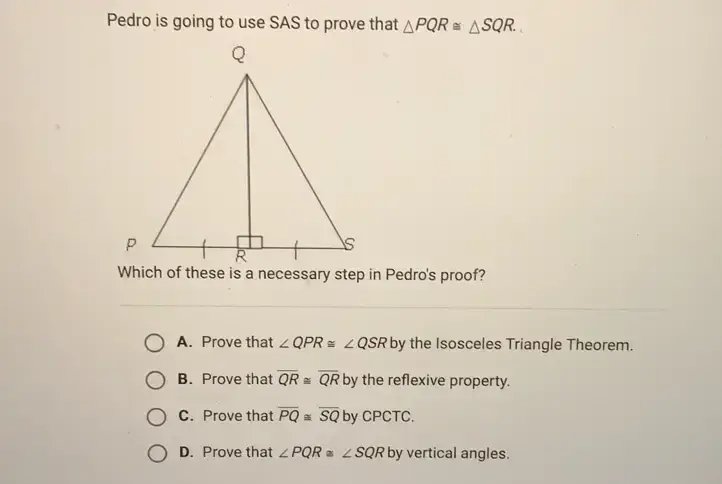
Answer: B. Prove that \( \overline{QR} \cong \overline{QR} \) by the reflexive property.
Explanation: To prove that \(\triangle PQR \cong \triangle SQR\) using the Side-Angle-Side (SAS) congruence theorem, we need to establish that two sides and the included angle of one triangle are congruent to two sides and the included angle of the other triangle. The reflexive property is used to show that the side \(\overline{QR}\) is congruent to itself, which is a necessary step in the proof.
Steps:
- Identify the triangles and the goal: We want to prove \(\triangle PQR \cong \triangle SQR\).
- Use the SAS Congruence Theorem: This theorem states that if two sides and the included angle of one triangle are congruent to two sides and the included angle of another triangle, then the triangles are congruent.
- Establish congruence of sides:
- \(\overline{QR} \cong \overline{QR}\) by the reflexive property. This is the side common to both triangles.
- Identify the included angle:
- \(\angle QRP = \angle QRS\) because they are both right angles.
- Prove congruence of the other sides:
- Since \(\overline{PR} \cong \overline{RS}\) (as indicated by the diagram showing equal segments), this satisfies the second side requirement.
- Conclude using SAS:
- With \(\overline{PR} \cong \overline{RS}\), \(\angle QRP = \angle QRS\), and \(\overline{QR} \cong \overline{QR}\), we can conclude \(\triangle PQR \cong \triangle SQR\) by SAS.
This step-by-step approach confirms that the reflexive property is crucial for proving the congruence of the triangles using SAS.