
Answer:
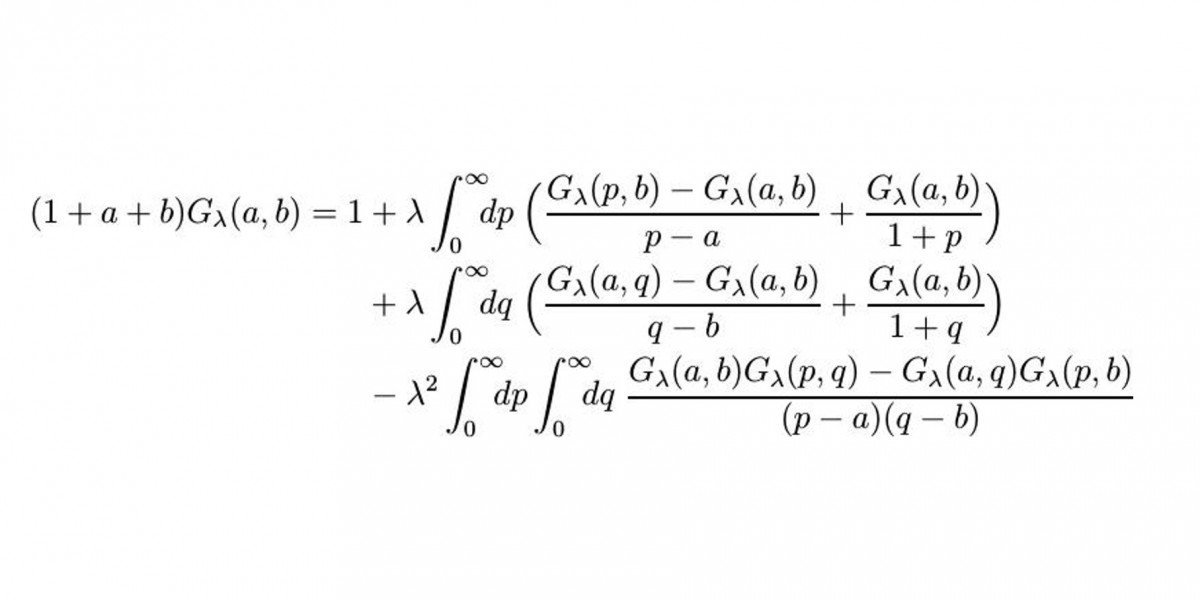
The expression is a complex integral equation involving the probability generating function \(G_\lambda(a, b)\), parameters \(a, b, p, q, \lambda\), and multiple integrals. Without specific numerical values, the exact simplified form cannot be directly computed, but the key concepts involved include the generating functions, integral transforms, and probability theory related to branching processes or stochastic models.
Explanation:
This equation appears to be derived from a probabilistic model, likely involving generating functions \(G_\lambda(a, b)\), which are often used in the analysis of branching processes, Markov chains, or renewal processes. The integrals over \(p\) and \(q\) suggest the use of Laplace transforms or probability density functions in the context of continuous distributions. The presence of the parameters \(a, b, p, q\), and \(\lambda\) indicates a model that accounts for multiple states or types, possibly in a multi-type branching process or interacting particle system.
The key theorems and concepts involved include:
- Generating functions: \(G_\lambda(a, b)\) likely encodes probabilities or expectations.
- Integral transforms: The integrals over \(p\) and \(q\) suggest the use of Laplace or Fourier transforms to handle distributions.
- Convolution: The structure of the integrals hints at convolution operations common in probability theory.
- Functional equations: The entire expression resembles a functional equation for the generating function, possibly derived via Kolmogorov equations or renewal equations.
Steps:
- Identify the generating function \(G_\lambda(a, b)\):
It encodes probabilities or expectations related to the process, possibly of offspring or transitions.
- Recognize the integral components:
- The integrals over \(p\) and \(q\) suggest averaging over distributions of certain random variables.
- The terms \(\frac{G_\lambda(p, b) - G_\lambda(a, b)}{p - a}\) and \(\frac{G_\lambda(a, q) - G_\lambda(a, b)}{q - b}\) resemble difference quotients, hinting at derivatives or sensitivities of the generating function with respect to parameters.
- Apply theorems:
- Use Fubini’s theorem to interchange integrals if needed.
- Recognize the structure as a functional equation for \(G_\lambda(a, b)\), possibly derived from Kolmogorov forward equations or renewal theory.
- Simplify the integrals:
- If the distributions of \(p\) and \(q\) are known, evaluate the integrals explicitly.
- Otherwise, interpret the integrals as operators acting on \(G_\lambda\).
- Identify the role of the \(\lambda\) parameter:
- \(\lambda\) could be a rate parameter, and the entire expression might be part of a Laplace transform of a probability distribution or a generating function for a process with parameter \(\lambda\).
- Final interpretation:
- The entire expression likely represents a generating function or moment-generating function of a complex stochastic process, with the integrals capturing the distributional aspects of the process.
Summary:
This integral equation involves advanced probabilistic concepts, primarily generating functions and integral transforms, used to analyze stochastic processes such as branching processes or Markov chains. The solution or simplification depends heavily on the specific forms of \(G_\lambda\) and the distributions of \(p\) and \(q\).