
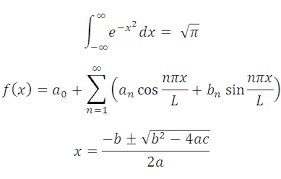
Answer: The integral evaluates to $\sqrt{\pi}$, and the quadratic formula provides the roots of the quadratic equation.
Explanation:
The integral $\int_{-\infty}^{\infty} e^{-x^2} dx$ is a well-known Gaussian integral, which equals $\sqrt{\pi}$. The series expansion of a function $f(x)$ involving Fourier coefficients suggests Fourier series concepts, with coefficients involving cosine and sine functions. The quadratic formula is used to find roots of the quadratic equation $ax^2 + bx + c = 0$, which appears in the context of solving for $x$ in the equation involving the discriminant $b^2 - 4ac$.
Steps:
- Evaluate the integral:
The integral
is a classic Gaussian integral. Its value is known from standard integral tables or derivations involving polar coordinates:
- Series expansion of $f(x)$:
The function
represents a Fourier series expansion of a periodic function with period $2L$. The Fourier coefficients $a_n$, $b_n$ are determined via integrals involving $f(x)$ and the orthogonal basis functions $\cos$ and $\sin$.
- Quadratic formula:
The roots of the quadratic equation
are given by the quadratic formula:
The discriminant $b^2 - 4ac$ determines the nature of the roots (real and distinct, real and equal, or complex).
Summary:
- The integral is a standard Gaussian integral with value $\sqrt{\pi}$.
- The Fourier series expansion involves orthogonal functions and Fourier coefficients.
- The quadratic formula is used to find roots of quadratic equations, involving the discriminant $b^2 - 4ac$.
If you need further clarification on any specific part, feel free to ask!