
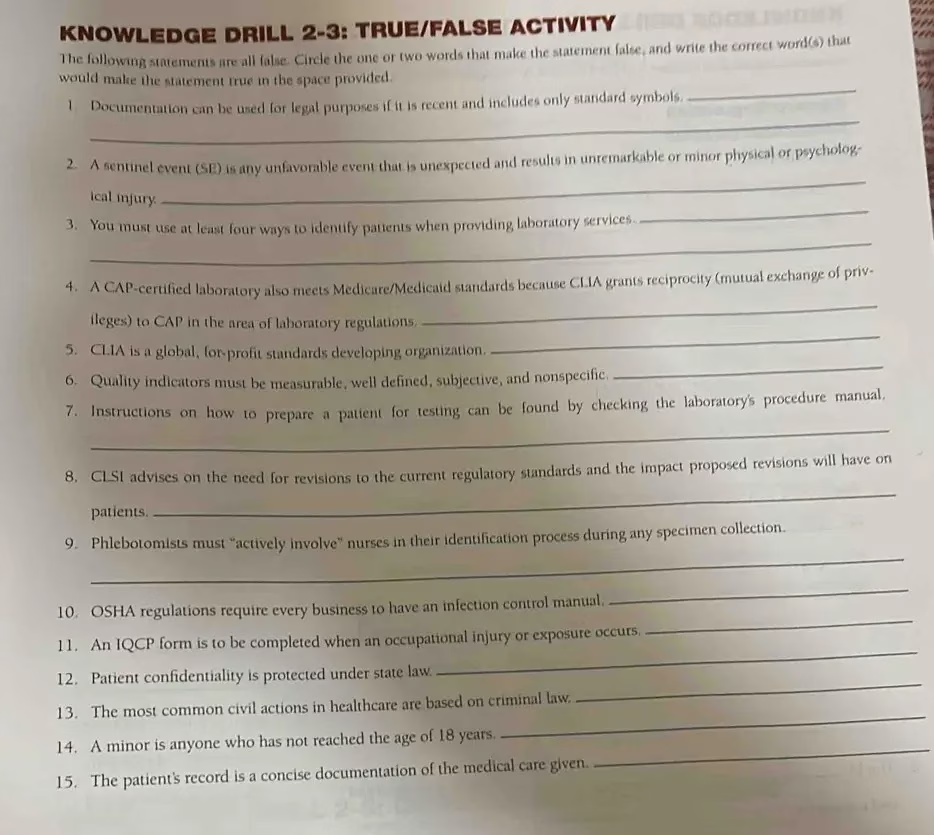
Answers (incorrect word(s) → correct word(s)):
Q1: incorrect: recent and standard → correct: accurate and approved
Explanation: Legal documentation must be accurate, complete, dated/legible, and use only approved (not unauthorized) abbreviations/symbols.
Q2: incorrect: unremarkable or minor → correct: serious or major (e.g., death or permanent harm)
Explanation: A sentinel event is an unexpected event that results in serious injury or death, not minor outcomes.
Q3: incorrect: four → correct: two
Explanation: Patient identification for laboratory services requires at least two unique identifiers (not four).
Q4: incorrect: CLIA grants reciprocity → correct: CMS grants deemed status (or: “CAP accreditation can meet CLIA requirements because CMS recognizes CAP as a deemed accreditor”)
Explanation: CMS (Centers for Medicare & Medicaid Services) may grant “deemed status” to organizations like CAP; CLIA is the regulatory framework, not the body granting reciprocity.
Q5: incorrect: global, for-profit standards developing organization → correct: a U.S. federal regulatory program (Clinical Laboratory Improvement Amendments)
Explanation: CLIA refers to a U.S. federal program/regulation (not a global, for‑profit SDO).
Q6: incorrect: subjective, and nonspecific → correct: objective and specific
Explanation: Quality indicators must be measurable, well defined, objective, and specific.
Q7: incorrect: procedure manual → correct: test directory (or specimen collection manual/test catalog)
Explanation: Patient preparation instructions are typically found in the laboratory’s test directory/specimen collection guidelines (not just an internal procedure manual).
Q8: incorrect: regulatory → correct: voluntary consensus (practice) standards/guidance
Explanation: CLSI develops voluntary consensus standards and guidance for laboratory practice; it issues standards and recommendations rather than acting as a regulatory body that revises laws.
Q9: incorrect: nurses → correct: patients (or the patient)
Explanation: Phlebotomists must actively involve the patient (and use proper identifiers) in the identification process; they do not have to involve nurses for every collection.
Q10: incorrect: infection control manual → correct: written exposure control plan
Explanation: OSHA requires a written exposure control plan (and other safety programs), not specifically an “infection control manual” for every business.
Q11: incorrect: IQCP form → correct: incident (or injury) report
Explanation: An IQCP (Individualized Quality Control Plan) relates to lab QC, whereas occupational injuries/exposures require an incident/injury report (and OSHA reporting as applicable).
Q12: incorrect: state → correct: federal (HIPAA) and state
Explanation: Patient confidentiality is protected by both federal law (HIPAA) and state laws/regulations.
Q13: incorrect: criminal → correct: tort (negligence)
Explanation: The most common civil actions in healthcare are based on tort law (e.g., negligence), not criminal law.
Q14: incorrect: 18 years → correct: the age of majority (varies by jurisdiction/state law)
Explanation: The definition of a minor or the age of majority can vary by jurisdiction and by context (e.g., medical consent, alcohol).
Q15: incorrect: concise → correct: complete and accurate
Explanation: A patient’s record should be a complete, accurate, and chronological documentation of care (not merely “concise”).
If you want, I can mark the exact words in each original sentence (showing the corrected full sentence) or provide references for any specific item.