
Answer:
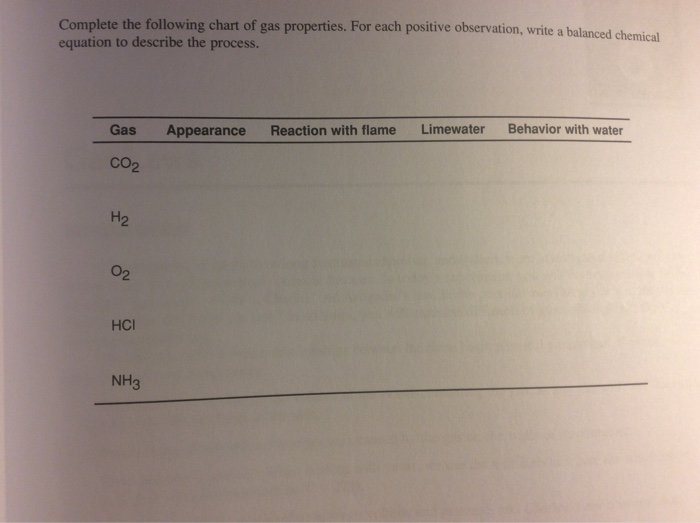
The subject is Chemistry. The task involves identifying the properties and reactions of various gases: CO₂, H₂, O₂, HCl, and NH₃.
Explanation:
To complete the chart, we need to understand the properties and reactions of each gas:
- CO₂ (Carbon Dioxide):
- Appearance: Colorless, odorless gas.
- Reaction with flame: Does not support combustion; extinguishes flames.
- Limewater: Turns limewater milky due to the formation of calcium carbonate.
- Behavior with water: Slightly soluble, forms carbonic acid.
- H₂ (Hydrogen):
- Appearance: Colorless, odorless gas.
- Reaction with flame: Burns with a pale blue flame, producing water.
- Limewater: No reaction.
- Behavior with water: Insoluble.
- O₂ (Oxygen):
- Appearance: Colorless, odorless gas.
- Reaction with flame: Supports combustion, reignites a glowing splint.
- Limewater: No reaction.
- Behavior with water: Slightly soluble.
- HCl (Hydrochloric Acid):
- Appearance: Colorless gas with a pungent odor.
- Reaction with flame: Does not burn.
- Limewater: No reaction.
- Behavior with water: Highly soluble, forms hydrochloric acid.
- NH₃ (Ammonia):
- Appearance: Colorless gas with a pungent odor.
- Reaction with flame: Burns with a yellowish flame in pure oxygen.
- Limewater: No reaction.
- Behavior with water: Highly soluble, forms ammonium hydroxide.
Steps:
- CO₂:
- Limewater Reaction:\[ \text{Ca(OH)}_2 + \text{CO}_2 \rightarrow \text{CaCO}_3 + \text{H}_2\text{O} \]
- Water Reaction:\[ \text{CO}_2 + \text{H}_2\text{O} \rightarrow \text{H}_2\text{CO}_3 \]
- H₂:
- Flame Reaction:\[ \text{2H}_2 + \text{O}_2 \rightarrow \text{2H}_2\text{O} \]
- O₂:
- Flame Reaction: Supports combustion, no specific equation unless combined with a fuel.
- HCl:
- Water Reaction:\[ \text{HCl} + \text{H}_2\text{O} \rightarrow \text{H}_3\text{O}^+ + \text{Cl}^- \]
- NH₃:
- Water Reaction:\[ \text{NH}_3 + \text{H}_2\text{O} \rightarrow \text{NH}_4^+ + \text{OH}^- \]
These reactions and properties help identify and describe the behavior of each gas in different scenarios.