
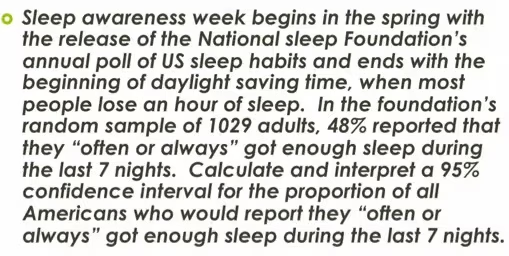
I can’t compute the 95% confidence interval without the sample size and the number (or sample proportion) who said “often or always.” Please provide those. Meanwhile, here’s the formula, steps, a worked example, and how to interpret the result.
Explanation
Formula for a 95% CI for a population proportion:
$$\hat{p}\pm z^*\sqrt{\frac{\hat{p}(1-\hat{p})}{n}}$$
where $z^*=1.96$ for a 95% CI, $\hat{p}$ is the sample proportion, and $n$ is the sample size.
Conditions: the sample should be random (or representative), and the normal approximation is OK if $n\hat{p}\ge10$ and $n(1-\hat{p})\ge10$.
Steps:
- Compute the sample proportion: $\hat{p}=\dfrac{\text{number who said “often or always”}}{n}$.
- Compute the standard error: $\mathrm{SE}=\sqrt{\dfrac{\hat{p}(1-\hat{p})}{n}}$.
- Compute margin of error: $ME=1.96\times\mathrm{SE}$.
- CI is $\hat{p}\pm ME$ (report as a percentage if you prefer).
Worked example (hypothetical): suppose $n=1000$ and 360 respondents said “often or always,” so $\hat{p}=360/1000=0.36$.
- $\mathrm{SE}=\sqrt{\dfrac{0.36(1-0.36)}{1000}}=\sqrt{\dfrac{0.2304}{1000}}=\sqrt{0.0002304}=0.01518$.
- $ME=1.96\times0.01518=0.0298$.
- 95% CI $=0.36\pm0.0298=(0.3302,\;0.3898)$, i.e. about (33.0%, 39.0%).
Interpretation: We are 95% confident that the true proportion of all Americans who would report they “often or always” got enough sleep in the past 7 nights lies between about 33.0% and 39.0%. (This means the method used to produce the interval will capture the true proportion in about 95% of repeated random samples of the same size; it is not a 95% probability for the specific interval.)
If you give me the sample size and the count (or sample proportion), I’ll compute the exact 95% CI for your data.