
Answer:
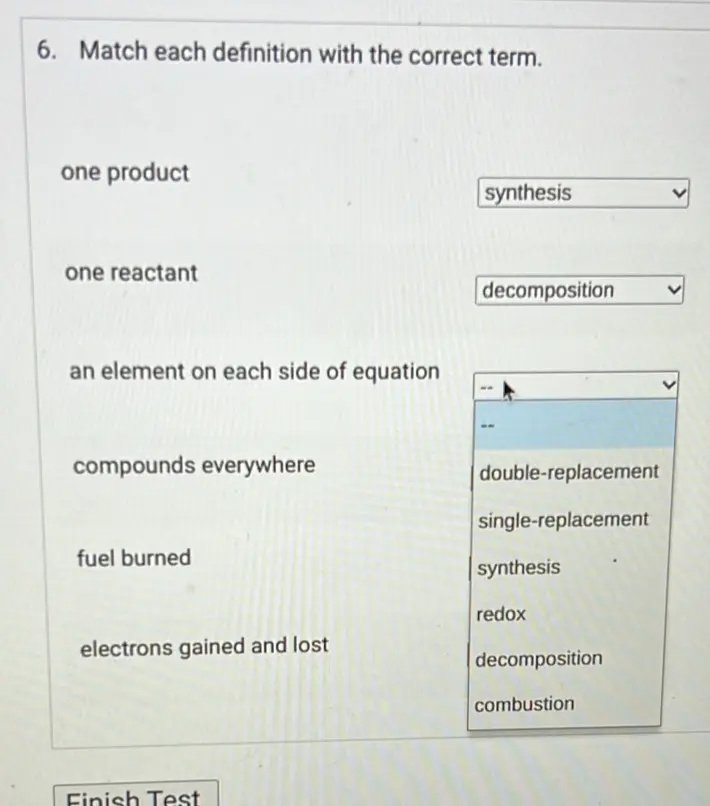
- One product – Synthesis
- One reactant – Decomposition
- An element on each side of equation – Single-replacement
- Compounds everywhere – Double-replacement
- Fuel burned – Combustion
- Electrons gained and lost – Redox
Explanation:
This problem involves matching chemical reaction types with their definitions. Each type of reaction has distinct characteristics:
- Synthesis Reaction: Involves combining two or more reactants to form a single product.
- Decomposition Reaction: A single compound breaks down into two or more simpler substances.
- Single-Replacement Reaction: An element in a compound is replaced by another element.
- Double-Replacement Reaction: Two compounds exchange ions or bonds to form different compounds.
- Combustion Reaction: A substance (often a hydrocarbon) reacts with oxygen, releasing energy in the form of light or heat.
- Redox Reaction: Involves the transfer of electrons between two species, resulting in oxidation and reduction.
Steps:
- Synthesis:
- Identify reactions where multiple reactants form a single product.
- Example: \( A + B \rightarrow AB \)
- Decomposition:
- Identify reactions where a single reactant breaks down into multiple products.
- Example: \( AB \rightarrow A + B \)
- Single-Replacement:
- Identify reactions where an element replaces another in a compound.
- Example: \( A + BC \rightarrow AC + B \)
- Double-Replacement:
- Identify reactions where components of two compounds swap places.
- Example: \( AB + CD \rightarrow AD + CB \)
- Combustion:
- Identify reactions involving oxygen and a fuel, producing heat and light.
- Example: \( C_xH_y + O_2 \rightarrow CO_2 + H_2O \)
- Redox:
- Identify reactions involving electron transfer, where oxidation and reduction occur.
- Example: \( \text{Zn} + \text{Cu}^{2+} \rightarrow \text{Zn}^{2+} + \text{Cu} \)
These definitions and examples help in identifying and matching the correct reaction types with their descriptions.