
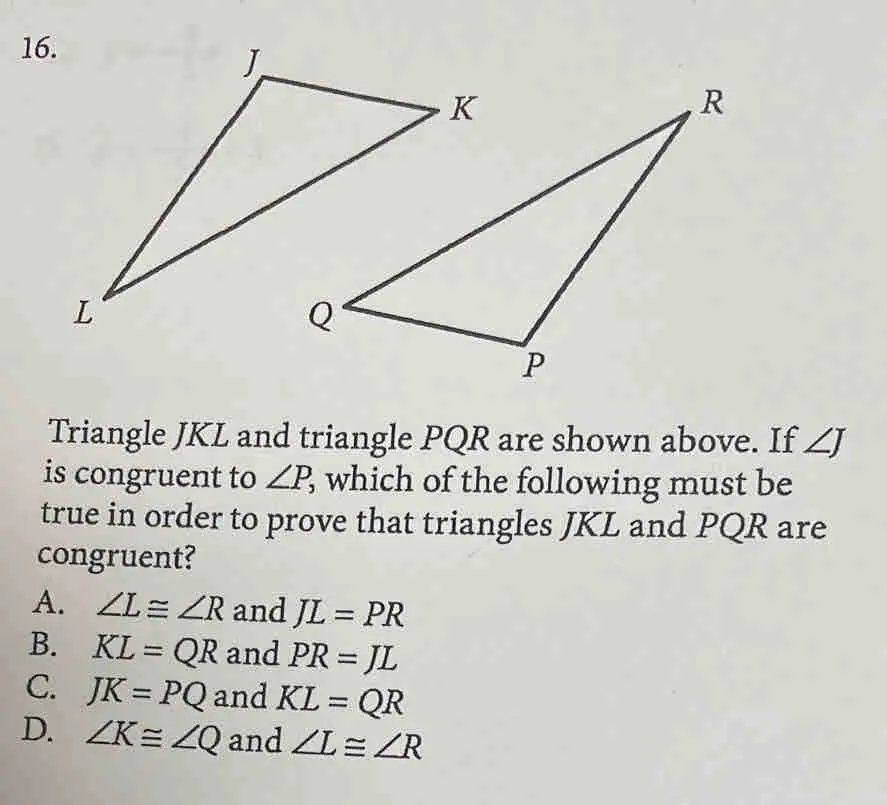
Answer: A. \(\angle L \equiv \angle R\) and \(JL = PR\)
Explanation: To prove that triangles \(JKL\) and \(PQR\) are congruent, we can use the Angle-Side-Angle (ASA) Congruence Theorem. This theorem states that if two angles and the included side of one triangle are congruent to two angles and the included side of another triangle, then the triangles are congruent.
Steps:
- Identify Given Information:
- \(\angle J \equiv \angle P\) is given.
- Apply ASA Congruence Theorem:
- We need another pair of angles and the included side to be congruent.
- Option A provides \(\angle L \equiv \angle R\) and \(JL = PR\).
- Verify ASA Conditions:
- \(\angle J \equiv \angle P\) (Given)
- \(\angle L \equiv \angle R\) (Option A)
- \(JL = PR\) (Option A)
- Conclusion:
- With \(\angle J \equiv \angle P\), \(\angle L \equiv \angle R\), and \(JL = PR\), the ASA conditions are satisfied, proving triangles \(JKL\) and \(PQR\) are congruent.
Thus, the correct choice is A, as it fulfills the requirements of the ASA Congruence Theorem.