
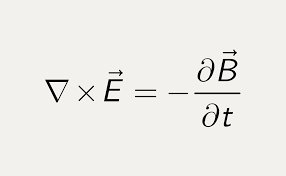
Answer: The equation shown is Faraday’s Law of Electromagnetic Induction in differential form.
Explanation:
This equation is a fundamental Maxwell’s equation describing how a time-varying magnetic field induces an electric field. It states that the curl of the electric field \(\vec{E}\) is equal to the negative rate of change of the magnetic flux density \(\vec{B}\) with respect to time. The theorem involved here is Maxwell’s Equations, specifically Faraday’s Law in differential form, which relates the changing magnetic field to the induced electric field.
Steps:
- Recognize the notation:
- \(\nabla \times \vec{E}\) is the curl of the electric field, representing the rotation or circulation of \(\vec{E}\) at a point in space.
- \(\frac{\partial \vec{B}}{\partial t}\) is the partial derivative of the magnetic flux density \(\vec{B}\) with respect to time, indicating how \(\vec{B}\) changes over time.
- Recall the physical principle:
- A changing magnetic field induces an electric field, which is a core concept in electromagnetism.
- The mathematical formulation:
- The equation \(\nabla \times \vec{E} = - \frac{\partial \vec{B}}{\partial t}\) is derived from Maxwell’s equations, specifically Faraday’s Law.
- The theorem involved:
- Maxwell’s Equations (specifically, the differential form of Faraday’s Law).
Summary:
This equation expresses that the curl of the electric field at a point is proportional to the negative rate of change of the magnetic flux density at that point, encapsulating how a time-varying magnetic field induces a circulating electric field.