
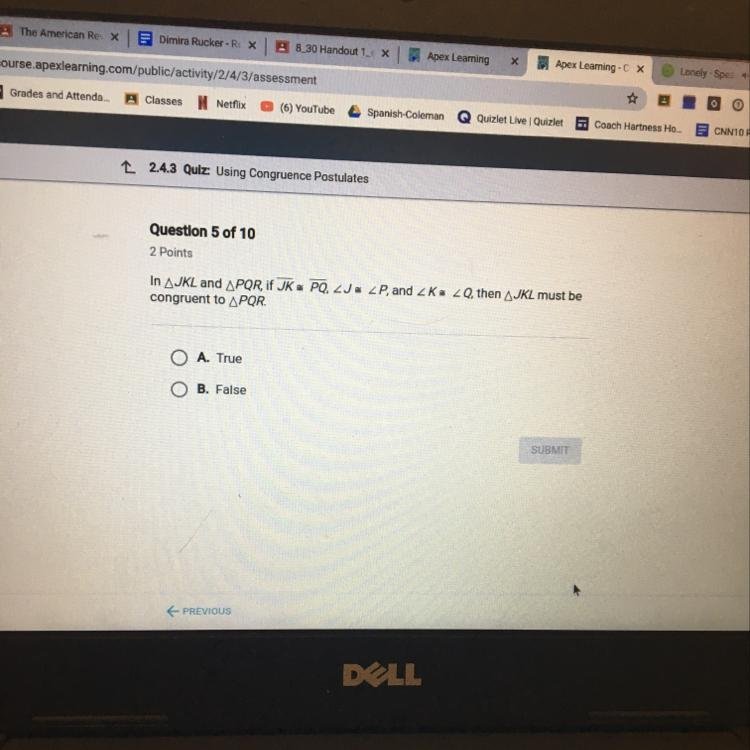
Answer: True
Explanation: Subject: Math — Geometry (triangle congruence). Relevant concept: ASA (Angle–Side–Angle) Congruence Postulate.
Given ∠J ≅ ∠P and ∠K ≅ ∠Q, and side JK ≅ PQ, the side JK is the side between angles J and K, and PQ is the side between angles P and Q. So we have two angles and the included side congruent (ASA), which guarantees the two triangles are congruent.
Steps:
- Match corresponding vertices: J ↔ P, K ↔ Q, L ↔ R.
- Note the given congruences: ∠J = ∠P, ∠K = ∠Q, and side JK = PQ.
- Observe that side JK is included between the two given angles ∠J and ∠K (and similarly PQ is included between ∠P and ∠Q).
- Apply the ASA Congruence Postulate: two triangles with two angles and the included side congruent are congruent.
- Conclude ΔJKL ≅ ΔPQR.