
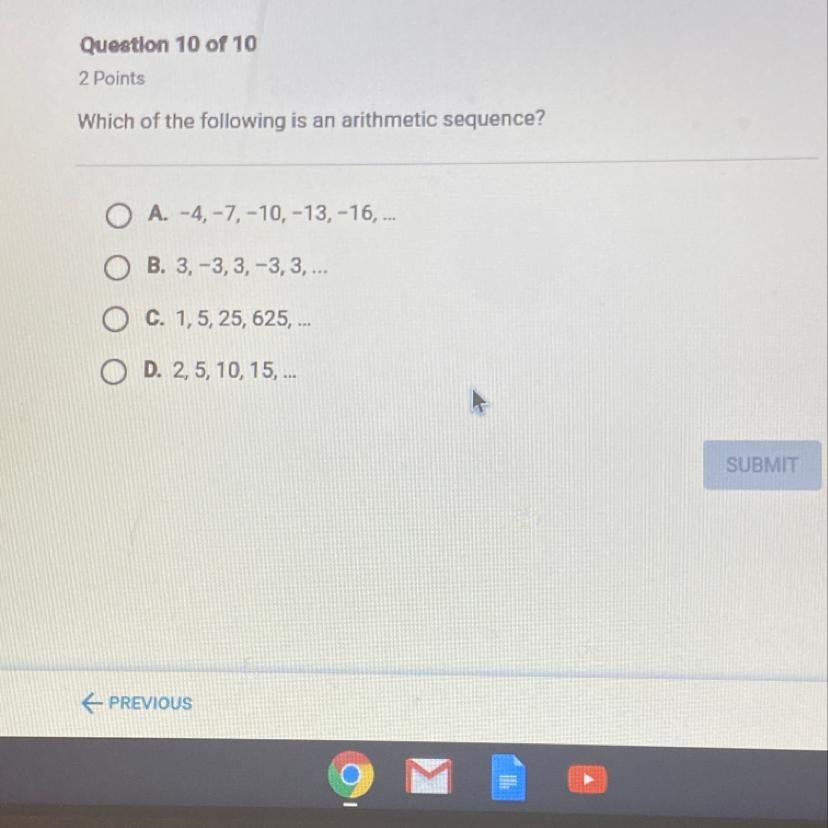
Answer: A. -4, -7, -10, -13, -16, …
Explanation: Subject: Math — sequences (arithmetic sequence / arithmetic progression). An arithmetic sequence has a constant difference d between consecutive terms; general term: \(a_n=a_1+(n-1)d\). To decide, compute consecutive differences for each choice and check whether they are all equal. Only choice A has a constant difference (-3), so it is arithmetic.
Steps:
- A: Differences: \(-7-(-4)=-3,\ -10-(-7)=-3,\ -13-(-10)=-3,\ -16-(-13)=-3\). All differences equal \(-3\) → arithmetic (common difference \(d=-3\)).
- B: 3, -3, 3, -3,… Differences: \(-6,\ 6,\ -6,\dots\) not constant → not arithmetic.
- C: 1, 5, 25, 625,… Differences: \(4,\ 20,\ 600\) (not constant). Ratios also not constant (1→5 ×5, 5→25 ×5, 25→625 ×25) → not arithmetic.
- D: 2, 5, 10, 15,… Differences: \(3,\ 5,\ 5\) not all equal (first difference differs) → not arithmetic.
Therefore option A is the arithmetic sequence.