
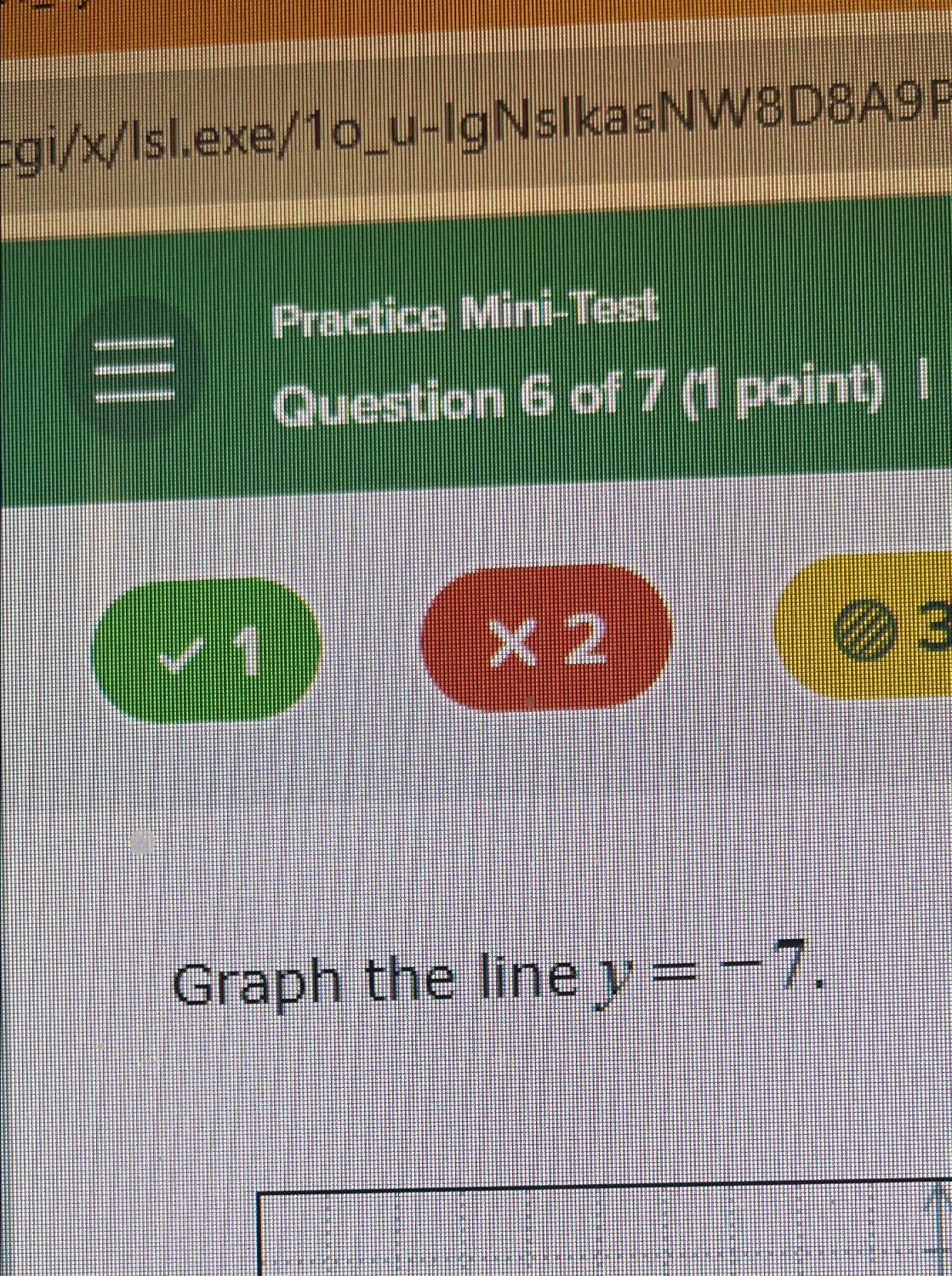
Answer: A horizontal line crossing the y-axis at \(y=-7\) (slope \(0\), y-intercept \((0,-7)\)).
Explanation:
Subject: Math — coordinate geometry / linear equations. Concept: The equation \(y=c\) (constant) is a horizontal line. Here \(y=-7\) means every point on the graph has \(y\)-coordinate \(-7\).
Steps (how to graph):
- Note the y-intercept: set \(x=0\) gives point \((0,-7)\).
- Pick additional x-values, e.g. \(x=1\) and \(x=-2\), giving points \((1,-7)\) and \((-2,-7)\).
- Plot those points on the coordinate plane and draw the straight horizontal line through them.
- State slope: \(m=0\) because the line is horizontal.
Any of the plotted points (for example \((0,-7),(1,-7),(-1,-7)\)) lie on the final horizontal line at \(y=-7\).