
Answer:
The subject is Chemistry, specifically focusing on the activity series of metals and their reactions with acids.
Explanation:
The activity series is a list of metals ranked by their reactivity. More reactive metals can displace less reactive metals from compounds. The questions involve arranging metals based on their reactivity and predicting their behavior in reactions with acids.
Steps:
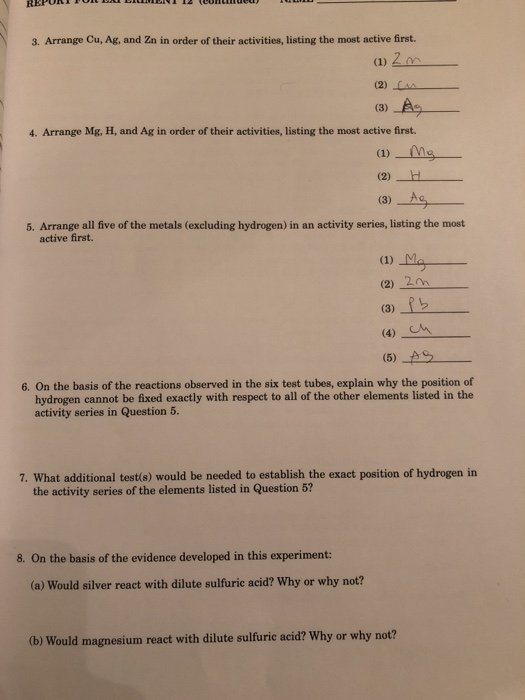
Q3: Arrange Cu, Ag, and Zn in order of their activities, listing the most active first.
- Answer: Zn, Cu, Ag
- Explanation: Zinc is more reactive than copper and silver, which is why it is listed first.
Q4: Arrange Mg, H, and Ag in order of their activities, listing the most active first.
- Answer: Mg, H, Ag
- Explanation: Magnesium is more reactive than hydrogen and silver.
Q5: Arrange all five of the metals (excluding hydrogen) in an activity series, listing the most active first.
- Answer: Mg, Zn, Pb, Cu, Ag
- Explanation: This order reflects the general activity series of these metals.
Q6: Explain why the position of hydrogen cannot be fixed exactly with respect to all of the other elements listed in the activity series in Question 5.
- Explanation: Hydrogen’s position varies because it reacts differently with different metals. Some metals can displace hydrogen from acids, while others cannot.
Q7: What additional test(s) would be needed to establish the exact position of hydrogen in the activity series?
- Answer: React each metal with dilute acid and observe if hydrogen gas is produced.
- Explanation: This would show which metals can displace hydrogen, helping to fix its position in the series.
Q8: On the basis of the evidence developed in this experiment:
(a) Would silver react with dilute sulfuric acid? Why or why not?
- Answer: No
- Explanation: Silver is less reactive than hydrogen and cannot displace it from sulfuric acid.
(b) Would magnesium react with dilute sulfuric acid? Why or why not?
- Answer: Yes
- Explanation: Magnesium is more reactive than hydrogen and can displace it from sulfuric acid, producing hydrogen gas.