
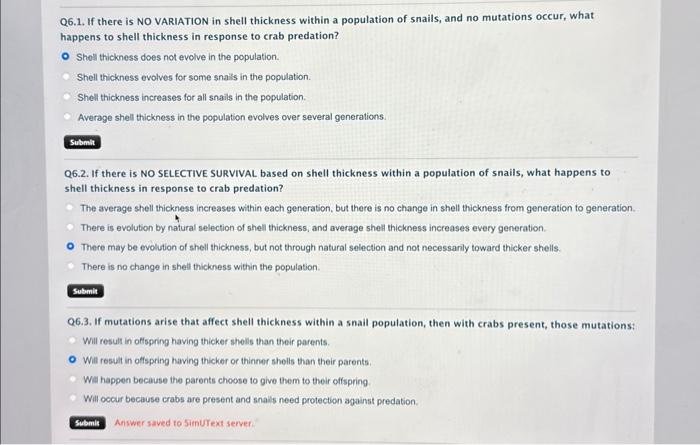
Q6.1. If there is NO VARIATION in shell thickness within a population of snails, and no mutations occur, what happens to shell thickness in response to crab predation? ○ Shell thickness does not evolve in the population. ○ Shell thickness evolves for some snails in the population. ○ Shell thickness increases for all snails in the population. ○ Average shell thickness in the population evolves over several generations. Submit Q6.2. If there is NO SELECTIVE SURVIVAL based on shell thickness within a population of snails, what happens to shell thickness in response to crab predation? ○ The average shell thickness increases within each generation, but there is no change in shell thickness from generation to generation. ○ There is evolution by natural selection of shell thickness, and average shell thickness increases every generation. ○ There may be evolution of shell thickness, but not through natural selection and not necessarily toward thicker shells. ○ There is no change in shell thickness within the population. Submit Q6.3. If mutations arise that affect shell thickness within a snail population, then with crabs present, those mutations: ○ Will result in offspring having thicker shells than their parents. ○ Will result in offspring having thicker or thinner shells than their parents. ○ Will happen because the parents choose to give them to their offspring. ○ Will occur because crabs are present and snails need protection against predation. Submit Answer saved to SimUText server.

Q6.1. If there is NO VARIATION in shell thickness within a population of snails, and no mutations occur, what happens to shell thickness in response to crab predation? ○ Shell thickness does not evolve in the population. ○ Shell thickness evolves for some snails in the population. ○ Shell thickness increases for all snails in the population. ○ Average shell thickness in the population evolves over several generations. Submit Q6.2. If there is NO SELECTIVE SURVIVAL based on shell thickness within a population of snails, what happens to shell thickness in response to crab predation? ○ The average shell thickness increases within each generation, but there is no change in shell thickness from generation to generation. ○ There is evolution by natural selection of shell thickness, and average shell thickness increases every generation. ○ There may be evolution of shell thickness, but not through natural selection and not necessarily toward thicker shells. ○ There is no change in shell thickness within the population. Submit Q6.3. If mutations arise that affect shell thickness within a snail population, then with crabs present, those mutations: ○ Will result in offspring having thicker shells than their parents. ○ Will result in offspring having thicker or thinner shells than their parents. ○ Will happen because the parents choose to give them to their offspring. ○ Will occur because crabs are present and snails need protection against predation. Submit Answer saved to SimUText server.

Subject: Biology (Evolution and Natural Selection)

Q1:
Answer: Shell thickness does not evolve in the population.

Explanation: Without variation or mutations, there is no genetic diversity for natural selection to act upon, so shell thickness remains unchanged.

Steps:

  1. Identify the lack of variation and mutations.
  2. Understand that evolution requires genetic variation.
  3. Conclude that without these, no evolutionary change occurs.

Q2:
Answer: There is no change in shell thickness within the population.

Explanation: Without selective survival, there is no differential reproduction based on shell thickness, so no evolutionary change occurs.

Steps:

  1. Recognize the absence of selective survival.
  2. Understand that natural selection requires differential survival and reproduction.
  3. Conclude that without selection, shell thickness remains constant.

Q3:
Answer: Will result in offspring having thicker or thinner shells than their parents.

Explanation: Mutations introduce genetic variation, which can lead to changes in traits like shell thickness, especially under environmental pressures like predation.

Steps:

  1. Acknowledge the role of mutations in creating variation.
  2. Recognize that environmental pressures can influence which mutations are advantageous.
  3. Conclude that offspring may have different shell thicknesses due to these mutations.

Related

the allele for black noses in wolves is dominant over the allele fro the brown noses. There is no known selective advantage for one nose colour over another in wolves. If this remains true, which of the following statements is most liklely TRUE about the change in wolf nose colours re over many generations? Black noses will become more common than they are now black noses will stay about the same frequency as now black noses will become less common than they are now brown noses wil disappear after enough generations pass