
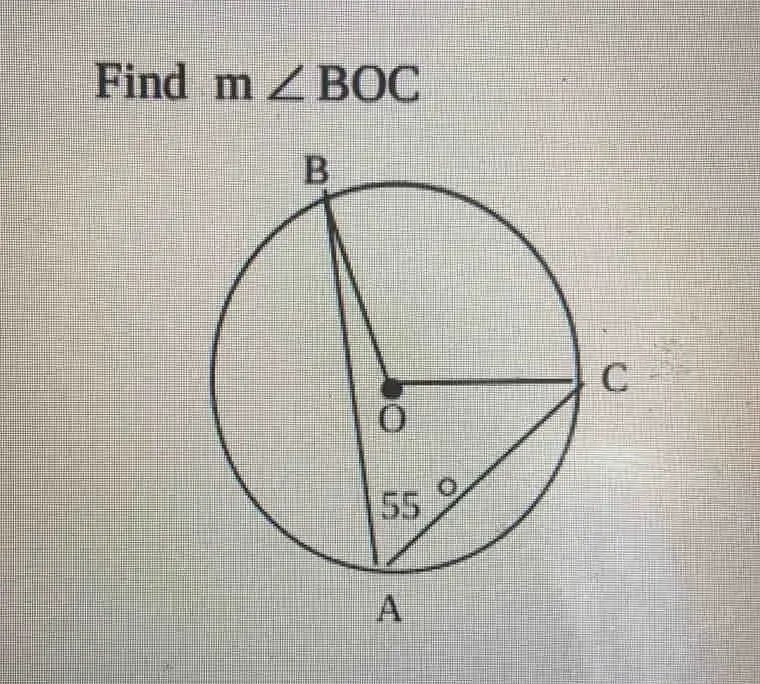
Answer: \(\angle BOC = 110^\circ\)
Explanation:
This problem involves properties of circles, specifically the relationship between inscribed angles, central angles, and the use of the inscribed angle theorem. The key concept here is that an inscribed angle subtends an arc, and the measure of the inscribed angle is half the measure of the arc it subtends. Additionally, the problem involves the fact that the sum of angles in a triangle and the properties of the circle’s angles.
Steps:
- Identify known angles and points:
- \(\angle BAC = 55^\circ\) (given)
- \(\angle A = 55^\circ\)
- \(O\) is the center of the circle
- \(B, C, A\) are points on the circle
- \( \angle BOC \) is the central angle we need to find
- Use the inscribed angle theorem:
- \(\angle BAC\) is an inscribed angle that subtends the arc \(BC\).
- The measure of the arc \(BC\) is twice \(\angle BAC\):
\[
\text{Arc } BC = 2 \times 55^\circ = 110^\circ
\]
- Relate the central angle \( \angle BOC \) to the arc \( BC \):
- The central angle \( \angle BOC \) subtends the same arc \( BC \).
- The measure of a central angle is equal to the measure of the arc it subtends:
\[
\angle BOC = \text{measure of arc } BC = 110^\circ
\]
Therefore, the measure of \(\angle BOC\) is 110°.
Summary:
- The key theorem used is the inscribed angle theorem, which states that an inscribed angle is half the measure of the arc it intercepts.
- The central angle theorem states that the central angle is equal to the measure of the intercepted arc.
- By applying these, we find \(\angle BOC = 110^\circ\).