
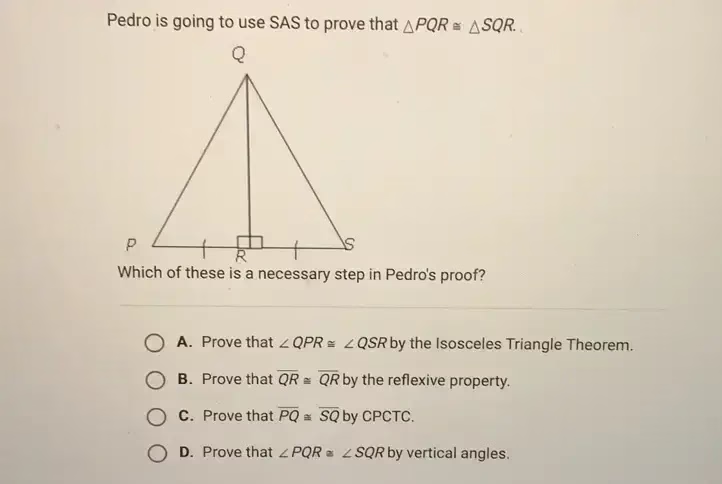
The correct answer is B.
Explanation
- To use SAS you need two pairs of corresponding sides and the included angle between them. A common and necessary step is to note the shared side:
QR ≅ QR (reflexive property).
- Why the others are wrong:
- A: The Isosceles Triangle Theorem applies only if you already know a triangle is isosceles; nothing in the statement guarantees that, so it’s not a necessary step.
- C: CPCTC (corresponding parts of congruent triangles are congruent) can only be used after the triangles are proven congruent — you cannot use it to prove congruence.
- D: ∠PQR and ∠SQR are adjacent angles that share side QR, not vertical angles, so you cannot claim they’re equal by the vertical-angles theorem.
Therefore showing QR ≅ QR by the reflexive property is a necessary step for a SAS proof.