
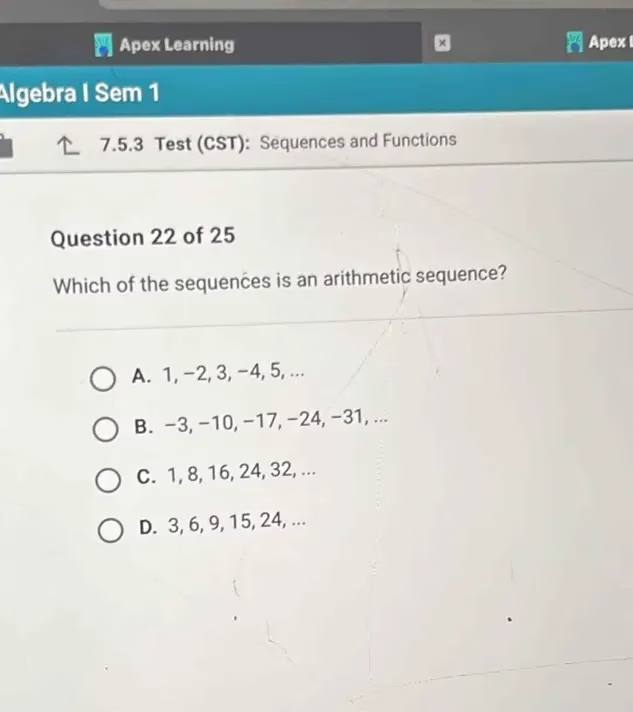
The answer is B. -3, -10, -17, -24, -31, …
Explanation
- Option A: 1, -2, 3, -4, 5, …
The difference between consecutive terms is not constant: $$-2 – 1 = -3$$, $$3 – (-2) = 5$$. Therefore, this is not an arithmetic sequence. - Option B: -3, -10, -17, -24, -31, …
The difference between consecutive terms is constant: $$-10 – (-3) = -7$$, $$-17 – (-10) = -7$$, $$-24 – (-17) = -7$$, $$-31 – (-24) = -7$$. Therefore, this is an arithmetic sequence. So Option B is correct. - Option C: 1, 8, 16, 24, 32, …
The difference between consecutive terms is not constant: $$8 – 1 = 7$$, $$16 – 8 = 8$$. Therefore, this is not an arithmetic sequence. - Option D: 3, 6, 9, 15, 24, …
The difference between consecutive terms is not constant: $$6 – 3 = 3$$, $$9 – 6 = 3$$, $$15 – 9 = 6$$. Therefore, this is not an arithmetic sequence.
Notice
This question focuses on identifying arithmetic sequences. An arithmetic sequence is a sequence of numbers such that the difference between consecutive terms is constant. This constant difference is called the common difference. To solve this, you need to examine each option and calculate the difference between each pair of adjacent numbers. For option A, the differences are -3, 5, -7, 9, which are not constant. For option B, the differences are -7, -7, -7, -7, which is constant. For option C, the differences are 7, 8, 8, 8, which are not constant. For option D, the differences are 3, 3, 6, 9, which are not constant. Therefore, option B is the only arithmetic sequence because it maintains a common difference of -7 throughout. This task develops your understanding of sequence types and the ability to apply the definition of an arithmetic sequence.