
Short answers (direct):
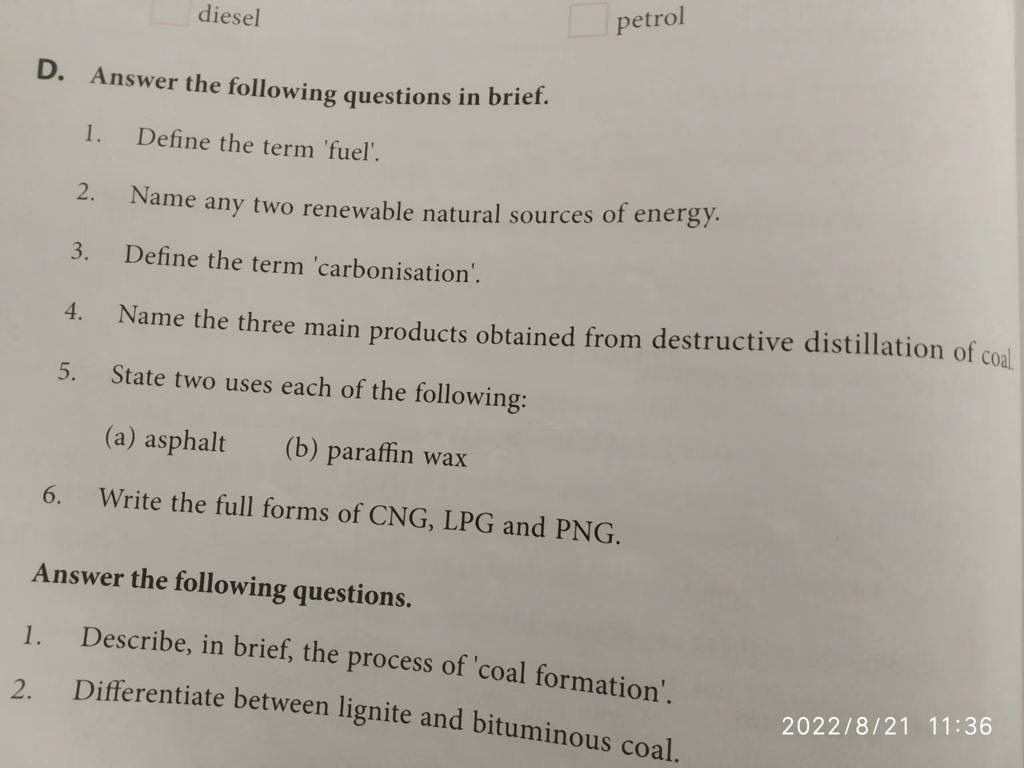
Q1: A fuel is a substance that releases energy (usually heat) when burned or undergoes chemical transformation.
Q2: Two renewable natural energy sources: solar energy and wind energy.
Q3: Carbonisation is the heating of organic material (like coal or biomass) in absence of air to remove volatile matter, producing carbon-rich solid (coke or charcoal).
Q4: Three main products of destructive distillation of coal: coke (or char), coal tar, and coal gas.
Q5: (a) Asphalt — road surfacing and waterproofing (e.g., roofs). (b) Paraffin wax — candle-making and polishing/coating (e.g., furniture or crayons).
Q6: CNG = Compressed Natural Gas; LPG = Liquefied Petroleum Gas; PNG = Piped Natural Gas (sometimes called Pipeline Natural Gas).
Q7: Describe, in brief, the process of coal formation
The correct answer is: Coal forms by the burial and transformation of plant material in anaerobic, swampy environments over geological time.
Explanation and steps:
- Plant accumulation: Dense vegetation in ancient swamps and peat bogs dies and accumulates as plant debris (peat) under waterlogged, oxygen-poor conditions that slow decay.
- Peat formation: Over time, the plant debris compacts and partially decomposes to form peat (low carbon, high moisture).
- Burial and coalification: Layers of sediment bury the peat. Increased pressure and temperature during burial drive off water and volatile compounds and progressively increase carbon content — a process called coalification.
- Coal ranks form with increasing depth/temperature/time: peat → lignite (brown coal) → sub-bituminous → bituminous coal → anthracite (highest carbon, hardest).
- Final product: The result is coal of varying rank and calorific value used as a fossil fuel and for industrial coke production.
Q8: Differentiate between lignite and bituminous coal
The correct answer is: Lignite is a low-rank, brownish coal with higher moisture and lower carbon content and calorific value; bituminous coal is a higher-rank, black coal with lower moisture, higher carbon content, and greater heating value.
Key differences (side-by-side):
- Rank and age: Lignite = low rank (younger); Bituminous = middle rank (older).
- Color & texture: Lignite = brownish, crumbly; Bituminous = dark black, harder/lustrous.
- Carbon content: Lignite ≈ 25–35% fixed carbon; Bituminous ≈ 45–86% fixed carbon (varies).
- Moisture & volatiles: Lignite has high moisture and volatile matter; bituminous has lower moisture, moderate volatile matter.
- Calorific value: Lignite = low (poor fuel efficiency); Bituminous = higher (good for electricity and industry).
- Uses: Lignite = local power generation (near mines); Bituminous = electricity generation, metallurgical coke (some grades), industrial heating.
If you want, I can make a one-line comparison table or add typical calorific values and examples of countries where each is mined.