
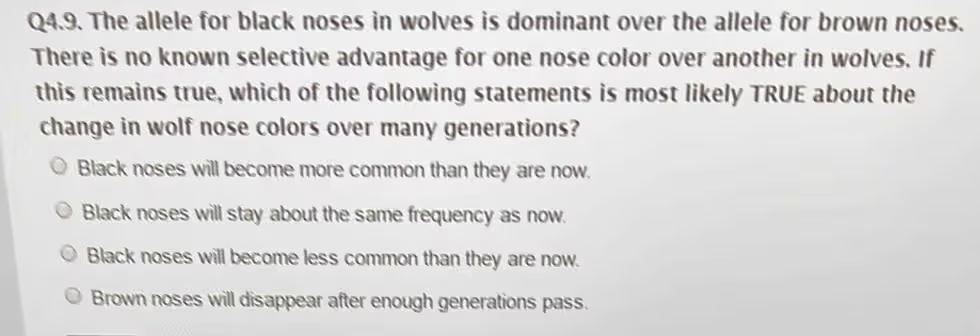
The correct answer is: Black noses will stay about the same frequency as now.
Explanation
When there is no selective advantage for either allele, allele frequencies are expected to remain constant across generations under the Hardy–Weinberg conditions (no selection, no mutation, no migration, random mating, and a very large population). Let $p$ be the frequency of the black-nose allele and $q$ the frequency of the brown-nose allele. Then
- $p+q=1$
- genotype frequencies are $p^2$ (homozygous dominant), $2pq$ (heterozygous), and $q^2$ (homozygous recessive), and these proportions remain the same each generation if the assumptions hold:
$$p^2+2pq+q^2=1.$$
A few clarifying points:
- Dominance (black being dominant) does not cause the black allele to increase in frequency by itself; it only affects phenotype expression.
- The brown (recessive) allele can persist hidden in heterozygotes ($2pq$), so it will not necessarily disappear.
- In real populations, genetic drift (random changes), migration, mutation, or nonrandom mating can cause frequencies to change, especially in small populations — but given “no known selective advantage,” the most likely expectation is stable frequencies.