
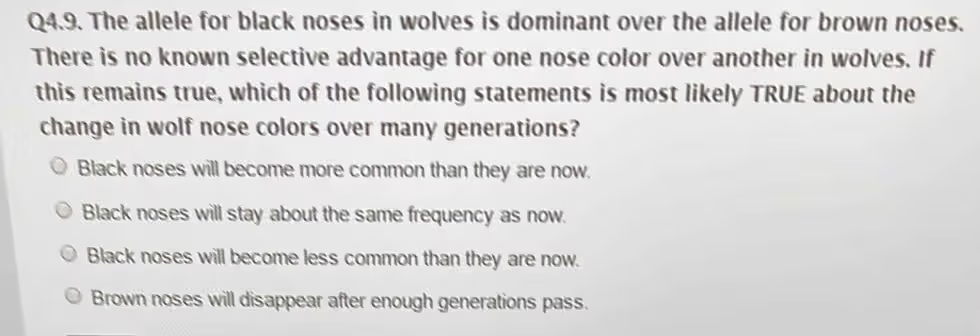
The most likely outcome: The frequencies of the black and brown nose alleles (and thus the phenotypic proportions) will remain approximately constant over many generations (i.e., the population will stay in Hardy–Weinberg equilibrium) if there is truly no selection.
Explanation
- Let $p$ = frequency of the black allele and $q$ = frequency of the brown allele ($p+q=1$).
- With random mating and no selection, mutation, migration, or very small population size, genotype frequencies reach and remain at $$p^2,\;2pq,\;q^2$$ for the homozygous-dominant, heterozygous, and homozygous-recessive genotypes.
- Because black is dominant, the proportion of black-nosed wolves is $p^2+2pq$ and brown-nosed is $q^2$ — these proportions stay constant generation-to-generation under Hardy–Weinberg conditions.
- Note: dominance alone does not change allele frequencies. Only forces like natural selection, genetic drift (important in small populations), mutation, or migration will change allele frequencies over time.